
What We Actually Pack for a National Park Day With Three Kids
After four months on the road, this is what actually makes it into our bags
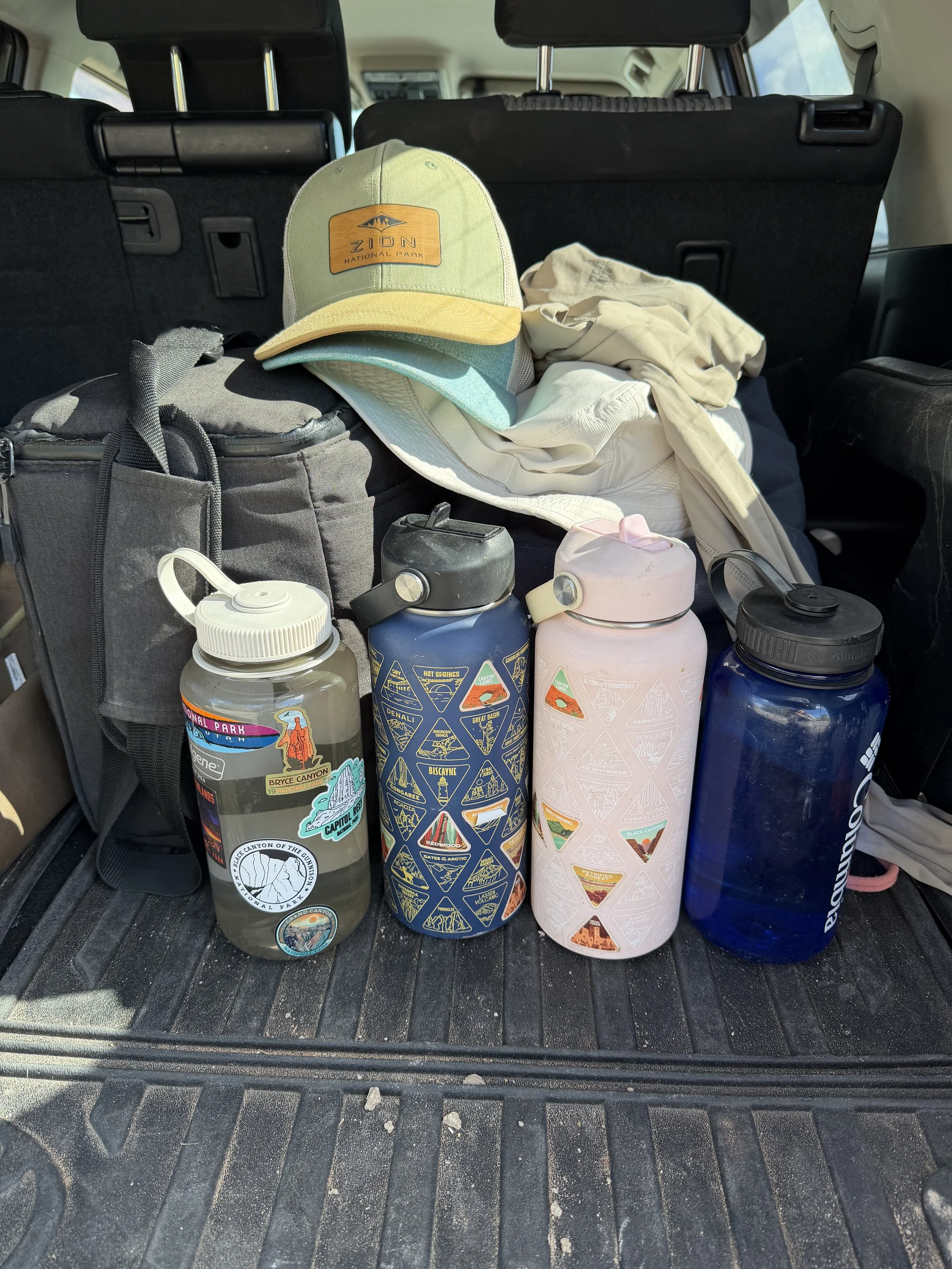
Before we started this trip, I could have made a very long list of everything a family might need for a day in a national park.
Extra clothes.
First aid supplies.
Food.
Water.
Maps.
Sunscreen.
Rain gear.
Emergency gear.
Activities for the kids.
And about 40 other things you could probably convince yourself were necessary.
Four months into traveling through national parks with three kids, our system has become much simpler.
We've hiked in desert heat.
Started trails before sunrise.
Been caught in pouring rain.
Hiked at elevation.
Spent entire days away from the RV.
Fished mountain lakes.
Sat through wildlife jams.
And dealt with plenty of hungry and tired kids.
We've definitely forgotten things.
We've carried things we didn't need.
And we've learned that some really simple items can make the difference between everyone having a great day and everyone being completely done.
So this isn't a list of everything you could bring into a national park.
This is what we actually bring.
Water. More Than We Think We'll Need.
This is always first.
How much we carry depends completely on where we're going and what we're doing.
A short walk around a visitor center isn't the same as hiking into the Grand Canyon.
When Jessie hiked from the South Kaibab Trail all the way to the Colorado River and back up Bright Angel, water and hydration weren't something he could figure out along the way.
The same was true when he took Hudson to Skeleton Point.
They started at 4:45 a.m. partly because they wanted to be back before the heat became a bigger problem.
Traveling through Utah and Arizona taught us quickly that heat changes everything.
Now I'd much rather finish a hike carrying extra water than realize halfway through that we didn't bring enough.
With three kids, I also don't count on everyone being great about drinking.
Sometimes we have to remind them.
Repeatedly.
Snacks. Then More Snacks.
I don't know how kids can eat breakfast, get into the car, and announce they're starving twenty minutes later.
But apparently they can.
Snacks have probably saved more national park days than any piece of expensive outdoor gear we own.
We try to bring things that are easy to eat on the move and things the kids actually like.
Because the middle of a hike isn't necessarily the time to introduce a healthy new snack everyone has already rejected at home.
Sometimes we stop because someone genuinely needs a break.
Other times I think everyone mostly needs food.
We've learned not to underestimate the difference a ten-minute snack break can make.
Lunch Usually Comes With Us
For bigger adventure days, we pack lunch.
That gives us freedom.
We aren't trying to reach a restaurant at exactly noon.
We don't have to leave an area because everyone is hungry.
And some of our favorite lunches have been incredibly simple.
Sitting on a rock.
Beside a lake.
At a viewpoint.
At a picnic table.
Shoes dirty.
Kids hungry.
Everyone eating whatever we threw into the bag that morning.
It isn't fancy.
But eating lunch beside a mountain lake beats waiting in line at a crowded national park restaurant almost every time.
Layers
This trip has made me much more appreciative of layers.
We've gone from cold mornings to hot afternoons.
We've been at high elevation where the temperature is completely different from the campground.
We've started before sunrise.
We've had wind.
Rain.
And weather that seemed perfectly fine until suddenly it wasn't.
Rocky Mountain National Park gave us the best lesson.
We hiked from Bear Lake toward Nymph, Dream, and Emerald Lakes.
Then the weather changed.
A huge thunderstorm moved in.
The trail filled with water.
We were soaked.
Thunder and lightning were way too close.
That day definitely reinforced the importance of paying attention to mountain weather.
It also reinforced something else:
A sunny morning doesn't mean you're getting a sunny afternoon.
Rain Jackets- sometimes
These now come along much more often.
Do the kids always want to carry them?
No.
Do they appreciate them when it starts raining?
Also sometimes no.
Because apparently wearing the jacket you complained about carrying does not erase the injustice of the rain existing.
But we bring them.
Especially in the mountains.
We've learned that weather changes too quickly to rely entirely on the forecast we checked at breakfast.
Good Shoes
Our kids don't need the most expensive hiking shoes on the market.
But they do need shoes that fit, have decent traction, and can handle the trail we're putting them on.
We've watched them cover a surprising number of miles on this trip.
And when you're asking a child to hike for several hours, footwear matters.
The same goes for adults.
A blister doesn't care that you're standing somewhere beautiful.
A Basic First Aid Kit
We aren't carrying a miniature hospital.
But we do want enough to deal with the common stuff.
Cuts.
Scrapes.
Blisters.
Minor injuries.
The kinds of things that happen when kids spend months climbing on rocks, hiking trails, fishing, and generally being kids outside.
Most days we don't touch it.
That's exactly how I want it.
But it comes anyway.
Sunscreen
The Southwest made this one pretty obvious.
There isn't much hiding from the sun on a lot of trails in Utah and Arizona.
Arches especially gave us plenty of days where shade was limited.
We put sunscreen on before leaving and carry it when we're going to be out long enough to need more.
Not exciting.
Still important.
Hats and Sunglasses
Same reason.
Sun.
Heat.
Exposure.
Our kids don't always keep their hats on as long as we'd like.
But we bring them.
A long exposed trail is not where I want to realize everyone's hats are sitting back at the RV.
Junior Ranger Books
These have become part of our national park routine.
If we've already stopped at the visitor center and picked up the Junior Ranger books, they usually come with us.
That way the kids can work on them while we're actually exploring.
They can identify something they see.
Answer questions.
Learn about wildlife.
Look at geology.
Instead of sitting at a table at the end of the day trying to remember everything.
The Junior Ranger program has become one of our favorite ways to keep the kids involved in what they're seeing.
And the badge at the end definitely helps.
Binoculars
Wildlife can turn an ordinary stop into one of the best moments of the day.
We've used binoculars for bears, elk, bison, deer, moose, and whatever else the kids spot.
Yellowstone obviously took this to another level.
When you're looking at a grizzly several hundred yards away in a meadow, binoculars change the experience completely.
They're also just fun for kids.
Give a kid binoculars and suddenly everything in the distance needs to be investigated.
Fishing Gear—Sometimes
This isn't going into the hiking bag every day.
But if there's a realistic opportunity to fish?
There's a pretty good chance Jessie is figuring out how to bring rods.
Fishing has become a much bigger part of this trip than I expected.
Sometimes it's the main activity.
Sometimes we fish at the end of a hike.
Sometimes it's something Jessie and the boys do in the evening.
And sometimes we carry fishing gear somewhere only to discover the fish have absolutely no interest in participating.
That's fishing.
But Hudson learning to fly fish and eventually looking at Jessie after catching one and saying:
“I think I'm finally getting it.”
made all those rods worth hauling around.
Bear Spray When We're in Bear Country
Once we reached areas with grizzly bears, bear awareness became part of hiking.
Bear spray needs to be accessible—not buried underneath lunch, three rain jackets, and somebody's Junior Ranger book.
We also talk with the kids about making noise ( which isnt hard ) , staying together, food, wildlife distance, and what we're supposed to do if we encounter a bear.
The goal isn't making them scared of being outside.
It's teaching them that being outdoors also means respecting where we are.
Our Phones
Obviously.
They're our cameras.
Maps.
Weather.
Trail information.
And communication when we have service.
But one thing we've learned is not to assume we'll have service.
National parks are really good at reminding you that your phone doesn't work everywhere.
Important maps and information need to be available before we're standing at a trailhead staring at a screen that won't load.
A Battery Pack on Longer Days
Our phones take a beating on big national park days.
Photos.
Video.
Navigation.
Maps.
Looking things up.
If we're going to be gone all day, having backup power is worth the small amount of space it takes.
Especially when we're relying on a phone for navigation.
A Bag for Garbage
Not exciting.
Very useful.
Five people generate garbage.
Snack wrappers.
Lunch.
Tissues.
Random things.
And we're not leaving any of it behind.
A simple bag keeps the inside of the backpack from turning into a garbage can.
What We DON'T Pack Anymore
This might be just as important.
We don't bring something simply because there's a chance we could need it.
Five people can create a ridiculous amount of stuff very quickly.
If every family member brings three “just in case” items, suddenly Jessie and I are carrying everyone's backup plans.
We've learned to look at the actual day.
What's the weather?
How far are we going?
How remote is it?
How much elevation?
Are we returning to the vehicle?
Are we hiking with all three kids?
Will we be near water?
Is there wildlife risk?
Then we pack for that adventure.
A paved boardwalk around a geyser basin does not require the same gear as hiking several miles into the mountains.
What Usually Stays in the 4Runner
This has become another part of our system.
Not everything needs to go onto the trail.
We keep additional supplies in the vehicle so we have them when we return.
Extra water.
Food.
Dry clothes.
Shoes.
Other gear depending on what we're doing.
That way we don't have to carry everything all day, but we aren't completely dependent on finding something inside the park either.
There is something wonderful about reaching the vehicle after a wet hike and knowing dry clothes are waiting.
Ask us how we learned that one.
The Most Important Thing Isn't in the Backpack
After four months, I've realized that what we carry matters.
But how we approach the day matters more.
Water won't stop a kid from complaining.
Expensive hiking shoes won't make every trail fun.
The perfect snack won't guarantee everyone is happy.
Sometimes the kids are tired.
Sometimes the weather changes.
Sometimes we turn around.
Sometimes the trail is harder than we expected.
And sometimes the adventure we planned simply isn't happening that day.
The gear helps us be prepared.
It doesn't control the adventure.
Pack for Your Family, Not Someone Else's
This is probably the biggest thing I'd tell another parent.
You don't need everything an outdoor gear website says you need.
But you also shouldn't skip something important because another family said they didn't carry it.
Think about your kids.
Your hike.
Your weather.
Your experience.
Your comfort level.
And your ability to handle something when the plan changes.
Our packing system isn't perfect.
I'm sure it will look different after eight months on the road than it does after four.
But right now, we've gotten it down to the things we actually use.
Water.
Food.
Layers.
Weather protection.
Basic safety gear.
Whatever we need for the adventure we're actually doing.
And probably more snacks.
Actually...
Definitely more snacks.
-Kayla